
The Decline
and what to do about it

The United States in decline. That’s my rational objective conclusion and with it comes feelings of sadness and fear. Sadness for what we have lost and have yet to lose. Fear of what is likely to happen during our decline and because it may be a very long time until our country rises again in some new way.
For years I held on to hope that the signs of decline were temporary. I wasn’t naive, but I had faith in our democracy and that the majority of Americans could and would choose to solve problems, to make things better. That hope, that faith are no more. The decline is real and won’t be over until it bottoms out and gives form to a new order.
My conclusion of decline is based on Ray Dalio’s book Principles for Dealing with the Changing World Order1. Dalio is the founder of Bridgewater Associates, a global asset manager and largest hedge fund in the world. His book is based on a study to understand three big forces that hadn’t happened before in his lifetime (he was born in 1949): 1) Very low interest rates2 at very high levels of debt, 2) Extremely wide wealth, values and political gaps and, 3) The U.S. encountering a true rival power (China).
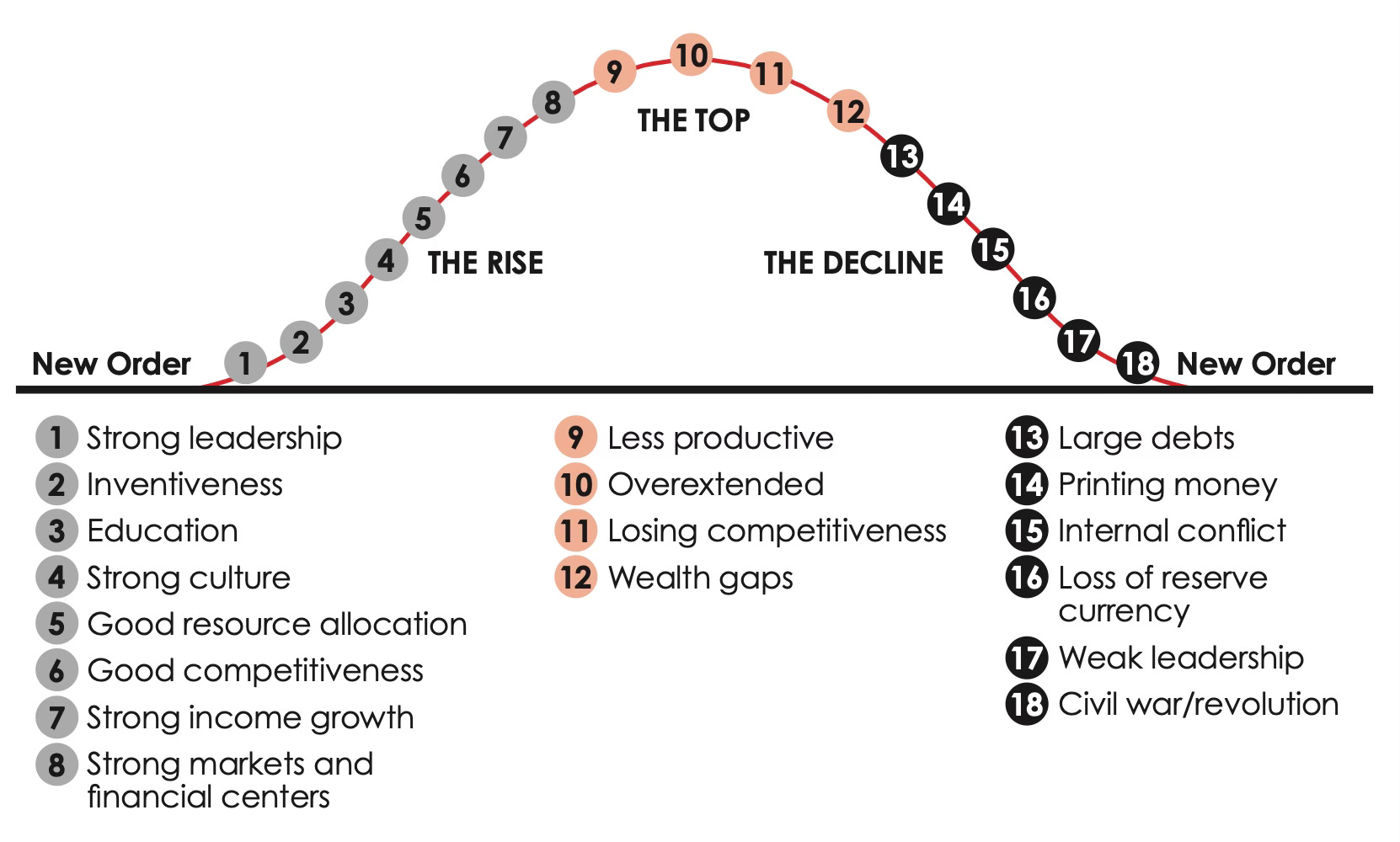
Dalio studied how the world has worked over the past 500 years, focusing on the British, Dutch, and U.S. empires and China. He concludes that there is an archetypical “Big Cycle” that governs “the rising and declining of empires and influences everything about them”3. This Big Cycle happens in three phases:
The Rise is the prosperous building with low levels of debt, small gaps in wealth, values and political power, people working cooperatively, good education and infrastructure, strong and capable leadership, and a peaceful world order.
The Top is a period of excesses, high debt, high levels of inequality, declining education and infrastructure, internal conflicts between different classes of people and struggles between countries.
The Decline is a painful period of fighting, great conflicts, great changes and the establishment of new internal and external orders. It sets the stage for the rise in the next cycle.
The forces that drive the Big Cycle and their progression are summarized in the following figure:
My main criticism of Dalio’s work is that it’s an oversimplification, viewing complex historical processes primarily through a financial lens. Crucially, it neglects powerful, novel factors like demographics, climate change, social media, AI, and genetic engineering that were absent from his historical data set. Despite this, I find his framework intuitively right, easy to grasp, and suitable for drawing big-picture conclusions.
I reached my conclusion that the United States is in decline by evaluating the 15 measures that define what stage of the Big Cycle a country is in.
Here is a summary of my assessment of each measure4 and which stage of the Big Cycle it indicates in parentheses:
Debt Burden: High Debt. The U.S. total public and private debt-to-GDP was estimated at 273% in 2024, roughly twice what it was in the 1950’s through 70’s5. Total public debt-to-GDP of 125% is at record levels6. (Decline)
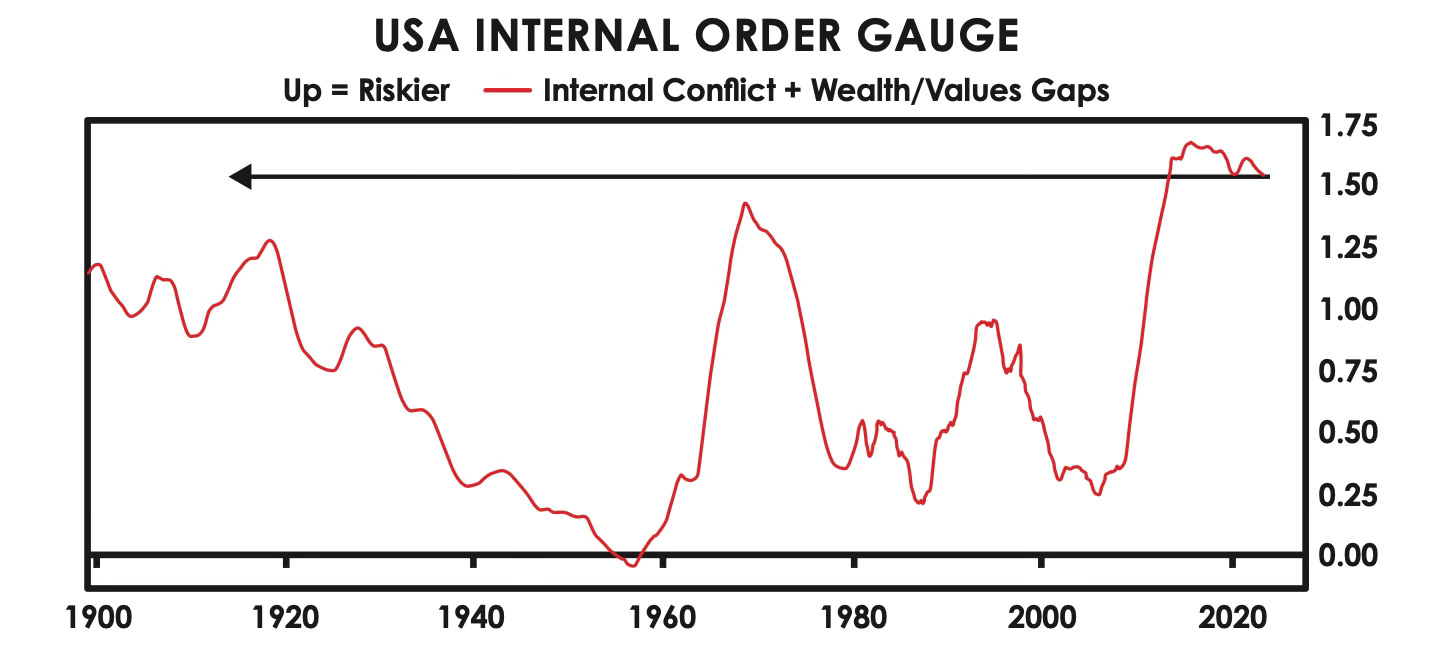
Internal Conflict: Very High. Partisanship is at historically high levels7, discontent is widespread8, the number of protests in the U.S. has tripled since 20179. (Decline)
Education: Strong, but weakening. U.S. literacy is at the international average, but numeracy and problem solving are below the average and both measures are declining10. However, undergraduate credentials earned in 2023-24 reached a new 10-year high for a third consecutive year11. U.S. colleges and universities are still ranked top in the world, but are being gutted by federal funding cuts and political pressures. (Top, trending towards Decline)
Innovation & Technology: Very Strong, but at risk. The U.S. ranked #2 in the 2024 Global Innovation Index12. Venture capital, AI and research in the private sector leads the world, but canceling of government research funding, interference with universities, and an anti-immigration, anti-science administration are major setbacks. (Top)
Cost Competitiveness: Weak. The U.S. ranks 63rd out of 69 economies for price competitiveness in the 2025 World Competitiveness Ranking, falling by four places from previous year13. (Decline)
Military Strength: Very Strong, but at risk? The U.S. currently has the most powerful military in the world and is largely apolitical. But is it being deployed effectively? Are sending troop to U.S. cities and taking out small drug-running boats distractions? How will senior officers react to political messaging from the President and Secretary of Defense14? (Top)
Trade: Very Strong, but at risk. The U.S. is the world’s 2nd largest trading nation, behind only China and the largest services exporter in the world. Will tariffs and the unpredictability of trade policy weaken us? (Top)
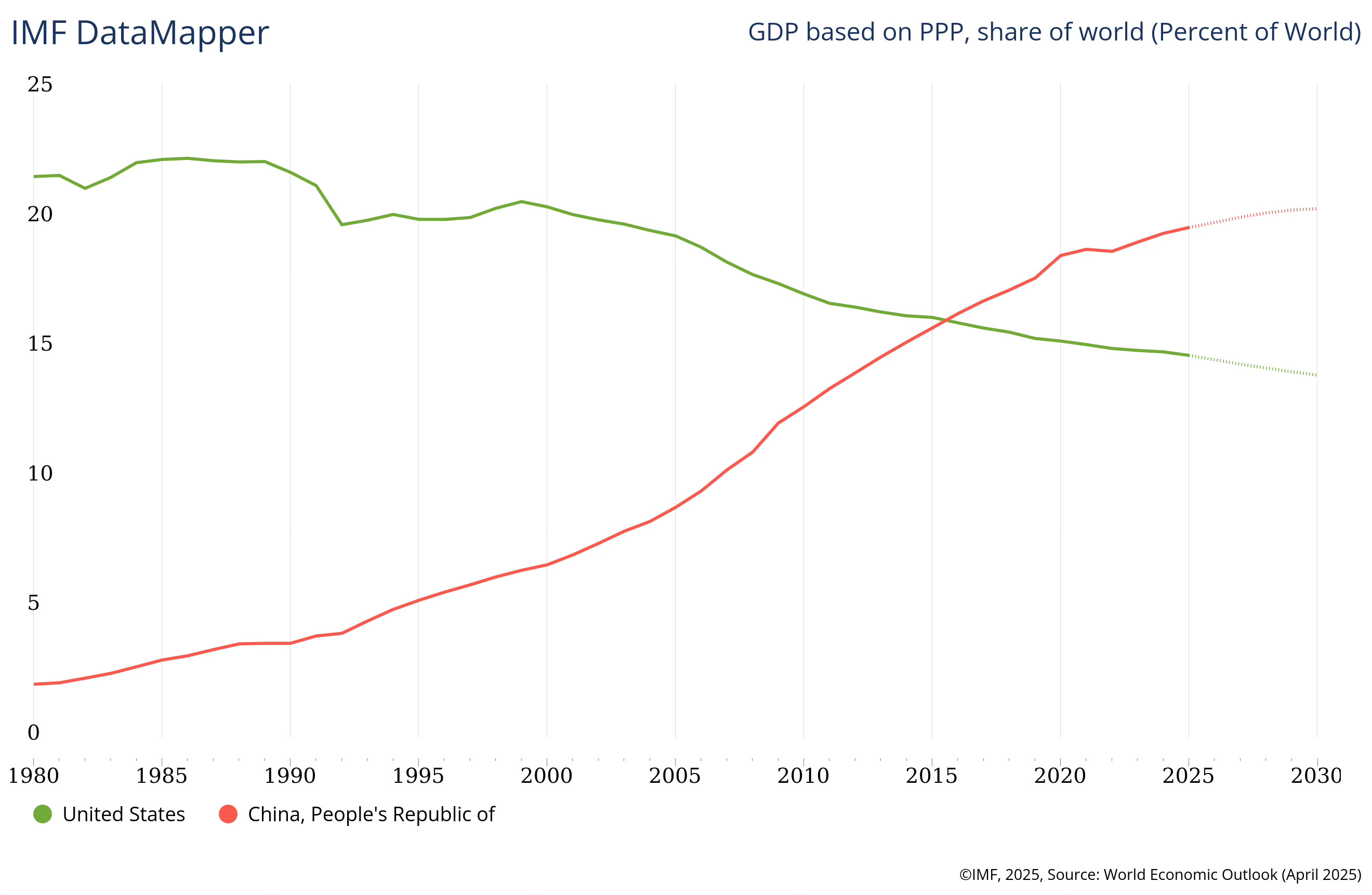
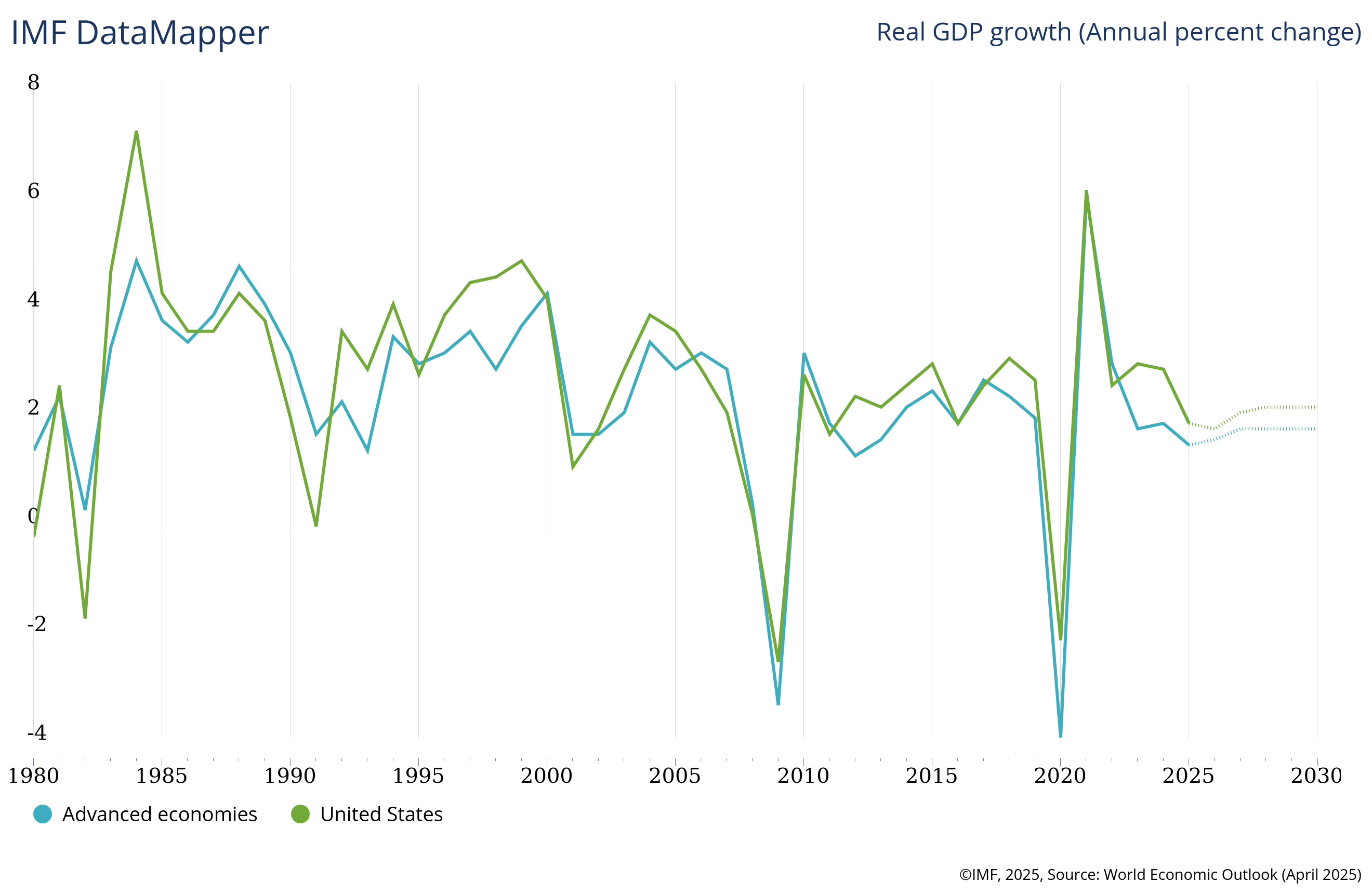
Economic Output: Very Strong. The U.S. is the second largest economy in the world, with a nearly 15% share of global GDP, though the share has been gradually shrinking over the past 25 years. Forecasted GDP growth through 2030 for the U.S. at around 2% is greater than the 1.7% forecast for advanced economies15. (Top)
Market & Financial Center: Very Strong. The U.S. remains the world’s top financial center by a significant margin. (Top)
Reserve Currency Status: Very Strong, but at risk. The U.S. dollar is the global reserve currency measured by transactions, debts and central bank reserves. However, threats to the independence of the Federal Reserve, high debt levels and the increasing use of economic sanctions are eroding its value; the dollar index declined by 6.9% this year16. (Top)
Resource Allocation Efficiency: Strong. The U.S. has relatively low unemployment and national income has grown just 6% less than debt over the past 10 years17. (Top)
Infrastructure & Investment: Strong, but declining. The U.S. ranks 11th out of 69 countries for overall infrastructure, falling from #6 in 202118. (Top)
Character/Civility/Determination: Strong, but declining. In 2021, 77% of Americans believed that hard work leads to success19. As of 2024, only 53% still believe the fundamental premise of the American Dream—that success is possible through effort and determination.20 (Top)
Governance/Rule of Law: Weakening. The rule of law remains generally strong at the state and local levels, though the quality of governance varies. However, the system is rapidly weakening at the top federal level. Congress is consistently ineffective. The Supreme Court frequently fails to explain its decisions and weakens lower courts. The executive branch is becoming authoritarian, often testing the limits of the Constitution and using its power to prosecute political rivals. Corruption goes uninvestigated, much less prosecuted. (Decline)
Gaps in Wealth, Opportunity & Values: Weak. The top 1% hold 31% of total U.S. wealth21, the bottom 50% hold only 2.5%22 , and partisanship is at all-time high23. (Decline)
Here’s how I see each of these measures map onto the stages of the cycle:
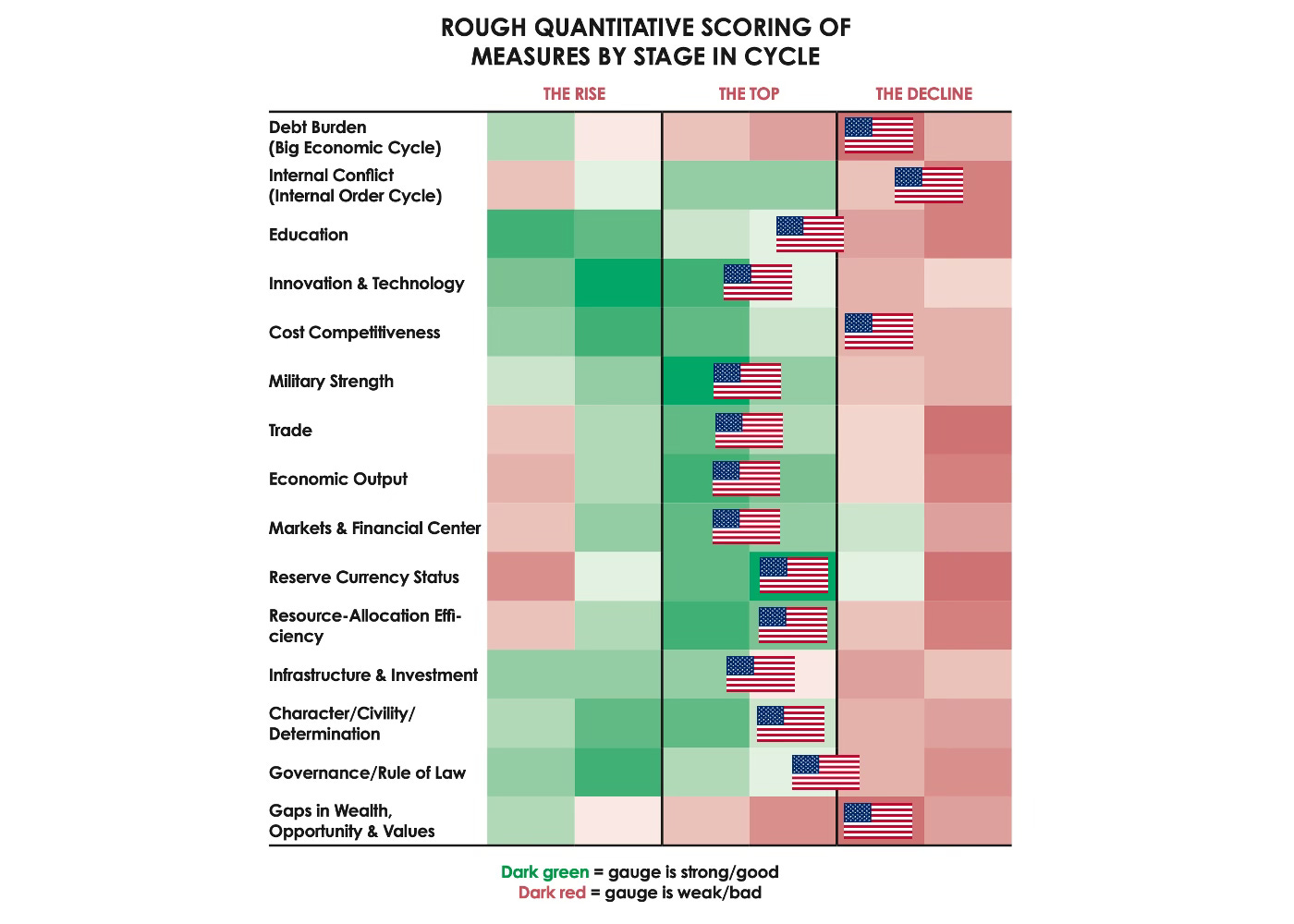
My overall conclusion is that, despite its economic and military strengths, the U.S. is in decline due to its debt burden, internal conflicts and societal gaps. The chart gives the impression that we are at the beginning of a gradual decline. I don’t see it that way because measures that are currently strong — education, innovation, military strength, trade, character, governance and rule of law — are all being actively and purposefully undermined by Trumpists. I predict that the decline will accelerate rapidly unless there is a regime change in the near future. Decline seems inevitable; the question is, how painful will it be and how long it will last?
What will happen during the decline? According to Dalio’s study of history, “Typically, the country’s decline comes gradually and then suddenly.”24
Very large debts result in an economic downturn, forcing the country to choose between defaulting on debts or printing a lot of new money.
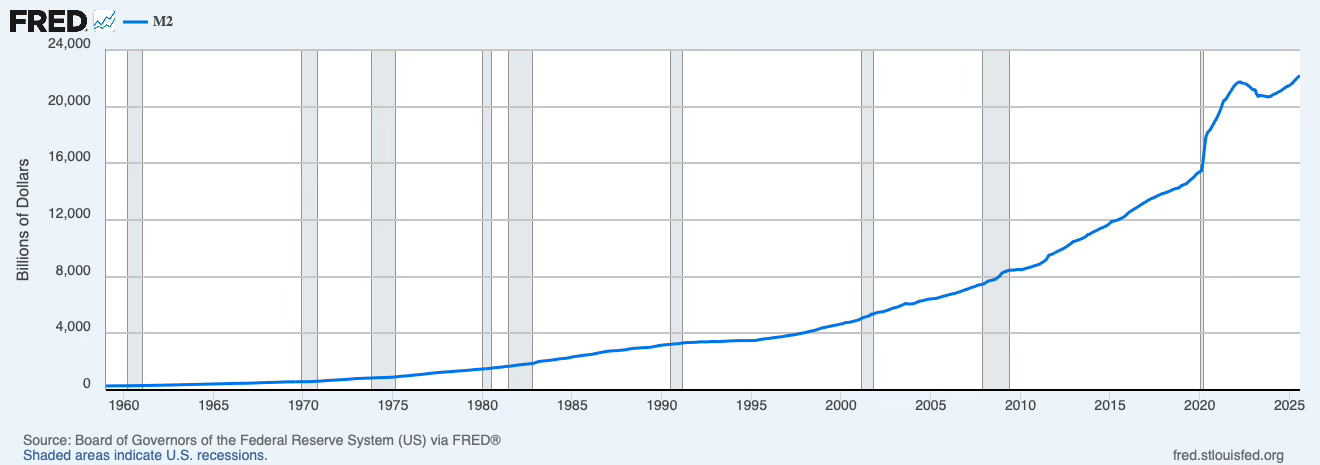
The country almost always chooses to print new money25, devaluing the currency and raising inflation.
There are great increases in conflict between rich and poor and different ethnic, religious and racial groups.
This leads to political extremism, that shows up as populism of the left or right and elites are blamed for the problems.
Taxes on the rich rise and the rich fear their wealth will be taken away, leading to capital outflows and reducing tax revenue, a self-reinforcing, hollowing-out process.
Turbulent conditions undermine productivity, which shrinks the economic pie and cause more conflict over how to divide it. This is when democracy is most challenged because it fails to control the anarchy, opening the way for a strong popular leader to take control.
As conflicts escalates, it leads to some form of revolution or civil war to redistribute wealth and force big changes. This can be peaceful and maintain the internal order, like Roosevelt’s New Deal revolution. It is more often violent and changes the order, like the revolutions in Germany, Japan, Spain, Russia and China, which also happened in the 1930’s.
What can we do about the decline? I see two opportunities that go hand-in-hand: 1)We can take measures to reduce the depth and duration of the decline, and; 2)we can start building the conditions for a new order, so the U.S. can rise again.
The best action we can take to mitigate the decline is to reduce the debt burden. Doing so will lesson the impacts of economic downturn, currency devaluation, inflation, the fundamental drivers of conflicts, populism and extremism. Dalio proposes a “3% 3-Part Solution”26:
I am confident that the government’s financial condition is at an inflection point because, if this is not dealt with now, the debts will build up to levels where they can’t be managed without great trauma, and it is especially important that this operation happens while the system is relatively strong rather than when it is weak. That is because when the economy is in a contraction, the government’s borrowing needs increase a lot.
From my analysis, I believe that this situation needs to be dealt with via what I call my 3% 3-part solution. That would be to get the budget deficit down to 3% of GDP in a way that balances the three ways of reducing the deficit, which are 1) cutting spending, 2) increasing tax revenue, and 3) lowering interest rates. All three need to happen concurrently so as to prevent any one from being too large because, if any one is too large, the adjustment will be traumatic…Based on my projections, spending cuts and tax revenue increases by about 5% each relative to current planning and interest rates falling by about 1-1.5% in response would lead to interest payments that are lower by 1-2% of GDP over the next decade and would stimulate a rise in asset prices and economic activity that would bring in much more revenue.
Unfortunately, such a rational and reasonable solution seems politically impossible.
Economic trauma thus appears inevitable—the central question is how we best navigate it. We need a vision for a new order, a concise and commonsense plan that most Americans can grasp. A strategy to preserve our national strengths while radically reorganizing to overcome weaknesses, thereby uniting the country and setting the stage for renewed peace and prosperity. Historically, the U.S. has used this approach—a unifying vision followed by a renaissance—to emerge stronger from crises like the Civil War, the Great Depression, and World War II, keeping us on a trend of ascending improvement.
I’m going to take a stab at developing such a plan. A humble, amateur, vigilant citizen effort to put out there and see what, if anything, becomes of it.
At the least, I’ll be able to say, “I tried.”
Dalio, Ray, Principles for Dealing with the Changing World Order, Avid Reader Press, 2021
When Dalio’s book was published 2021, the federal funds effective rate was 0.8%, the 10-year bond yield was 1.6% and inflation was running about 6%, resulting in negative real interest rates. Today, the federal funds rate and 10-year bond yield are both 4.1%, the 10-and inflation is around 3.4%. Debt is getting more expensive.
Dalio, Changing World Order, 26
For assessment measures see Dalio, Changing World Order, 506-511
International Monetary Fund, “2024 Global Debt Monitor” (2024), https://www.imf.org/external/datamapper/GDD/2024%20Global%20Debt%20Monitor.pdf
“The Growing National Debt”, Fiscal Data, U.S. Treasury, last updated 30 September 2025, https://fiscaldata.treasury.gov/americas-finance-guide/national-debt/#the-growing-national-debt
“U.S. Political Parties Historically Polarized Ideologically”, Gallup, 16 January 2025, https://news.gallup.com/poll/655190/political-parties-historically-polarized-ideologically.aspx#:~:text=In%202024%2C%20conservatives%20and%20moderates,conservative%20and%20Democrats%20as%20liberal
“America’s Cultural Crossroads: Enduring Discontent, Rising Disconnection, and an Uncertain Future”, Survey Center on American Life (American Enterprise Institute), 2 July 2025, https://www.americansurveycenter.org/research/a-cultural-crossroads-americas-uncertain-future-amidst-enduring-discontent-and-rising-disconnection/
“Why are there so many protests? The US public is highly polarized, and that drives people to act”, The Conversation, 22 September 2025, https://theconversation.com/why-are-there-so-many-protests-the-us-public-is-highly-polarized-and-that-drives-people-to-act-263021?utm_medium=article_clipboard_share&utm_source=theconversation.com
“U.S. Adults Score on Par With International Average in Literacy Skills, Below International Average in Numeracy and Problem-Solving Skills in Survey of Adult Skills”, National Center for Educational Statistics, 10 December 2024, https://nces.ed.gov/whatsnew/press_releases/12_10_2024.asp#:~:text=NAEP%20Press%20Releases-,U.S.%20Adults%20Score%20on%20Par%20With%20International%20Average%20in%20Literacy,lower%20than%20the%20international%20averages.
“Undergraduate Degree Earners, Academic Year 2023-24”, National Student Clearinghouse Research Center, 10 April 2025, https://nscresearchcenter.org/undergraduate-degree-earners/
“GII 2024 results”, World Intellectual Property Organization, 2024, https://www.wipo.int/web-publications/global-innovation-index-2024/en/gii-2024-results.html
“World Competitiveness Ranking 2025, USA”, International Institute for Management Development (IMD), 2025, https://www.imd.org/entity-profile/usa-wcr/
Yet the biggest gathering of top brass that anyone can remember was vacuous. There was no guidance about how to deal with China, say, or how to manage the war in Ukraine. As the brass hurried back to their billets before the looming government shutdown, what would they have made of it all? At best it was a money-wasting pep-talk, at worst an attempt to draw them into the political and culture wars at home. Most alarming, perhaps, the commanders got a close-up view of how erratic their civilian leaders could be.
“The president tries to enlist the top brass for ‘the war from within’”, The Economist, updated 3 October 2025, https://www.economist.com/united-states/2025/09/30/the-president-tries-to-enlist-the-top-brass-for-the-war-from-within
“Real GDP growth”, International Monetary Fund (IMF Datamapper), April 2025, https://www.imf.org/external/datamapper/NGDP_RPCH@WEO/OEMDC/ADVEC/WEOWORLD
“Nominal Broad U.S. Dollar Index”, Federal Reserve Economic Data (FRED), 13 October 2025, https://fred.stlouisfed.org/series/DTWEXBGS
“Total outstanding public and private debt across all sectors in the United States from 2000 to 2024”, Statistica, 30 September 2025, https://www.statista.com/statistics/1083150/total-us-debt-across-all-sectors/
“Net national factor income”, Federal Reserve Economic Data (FRED), 25 September 2025, https://fred.stlouisfed.org/series/X032RC1Q027SBEA
IMD, “World Competitiveness Ranking 2025, USA”
“Chapter 4. the Casualties: Faith in Hard Work and Capitalism”, Pervasive Gloom About the World Economy, Pew Research Center, 12 July 2012, https://www.pewresearch.org/global/2012/07/12/chapter-4-the-casualties-faith-in-hard-work-and-capitalism/
“Americans are split over the state of the American dream”, Pew Research Center, 2 July 2024, https://www.pewresearch.org/short-reads/2024/07/02/americans-are-split-over-the-state-of-the-american-dream/
“Share of Net Worth Held by the Top 1%”, Federal Reserve Economic Data (FRED), 19 September 2025, https://fred.stlouisfed.org/series/WFRBST01134
“Share of Net Worth Held by the Bottom 50%,” Federal Reserve Economic Data (FRED), 19 September 2025, https://fred.stlouisfed.org/series/WFRBSB50215
“U.S. Political Parties Historically Polarized Ideologically”, Gallup, 16 January 2025, https://news.gallup.com/poll/655190/political-parties-historically-polarized-ideologically.aspx
Dalio, Changing World Order, 49-50
The U.S. has been choosing to print new money, with a very steep rise in the money supply (M2) from 2020 to 2022 as shown by the following chart:
“How Countries Go Broke: The Big Cycle In a 5-Minute Read”, Principled Perspectives, 3 June 2025, https://www.linkedin.com/pulse/how-countries-go-broke-big-cycle-tiny-nutshell-ray-dalio-flnce/?trackingId=sPZ0TnNQQtG8oyBwCcfhuw%3D%3D
Excellent analysys! It ties so well with your earlier post on global power shifts.
Good solid summary. Debt will not be decreased; we are well beyond that point. We are in the middle of a class war in the U.S. “There isn’t enough to go around.” Scarcity thinking of the billionaire class and almost everyone. Hoarding. Preparation for a dystopian future.
Yes we are completely lacking in a vision and narrative for a way forward for the average person. Breaking ground on that is critical.
The U.S. Congress is irreparable. We are a few court cases away from the U.S. Supreme Court having reached fundamental abandonment of the Constitution intentionally.
The new narrative may well flip scarcity thinking. The current narrative is about the billionaire class hoarding everything and assuming that they no longer need a human working class.
I think we have yet to experience any pain. Trump is building a modern bunker underneath that new ballroom. Congress and the Supreme Court and the billionaires all share a similar bunker mentality of the end times.