
Notes
Zero-Sum Mindset, Public Choice Theory, Bad Faith, Trumpcare, Opposition Party Power

I’ve discovered that trying to write a Weekly Review is counter to my commitment to “slow journalism”. While holding to a deadline does push me along, it also gets in the way of writing more thoughtful articles of interest to vigilant citizens. These articles require a fair amount of research and take some time to write. So rather than diverting effort from them to write a Weekly Review, I’m going to share my research Notes from time-to-time. Hopefully this strikes a balance between frequency and depth of my articles and lets me work at my own pace.
I’m finding my attention drawn to morals and ethics and how they seem so often to be overlooked or passed by in government and politics. The system seems so corrupted, voters seem to be sucked into a rewards system that is counter to the common good, and checks and balances to power seem wanting. Here are some of my research notes around these lines of thought:
Zero-Sum vs. Positive-Sum Mindset
Zero-sum thinking is when one sees one person’s or group’s gain as another’s loss, the total of all gains and losses adding up to zero. This mindset is counter to thinking in terms of the common good, where the sum of gains and losses is positive overall for society.
A recent article in The Economist1 provides examples of zero-sum mindsets in public policies:
Look at the news or social media these days, and you might see a pattern. Stories are about groups in conflict, competing for limited resources, with the gains for some framed as losses for others. If China benefits from trade with America, America must lose. If foreign students enroll at American universities, that must mean fewer spots for Americans. If immigrants find work, they must be taking jobs from citizens. If a diversity initiative helps women or a racial minority, someone else must be left out. More and more, debates are shaped by a mindset that sees the world as a fixed pie—where one person’s or one group’s gain is another’s loss. That mindset is known as zero-sum thinking. And it is crucial to understanding the politics and economics of America today.
The tendency towards zero-sum or positive-sum mindset is based on people’s economic environment and experiences. It’s not just a bias, it’s shaped by what people have lived through. Policy can shape these conditions to make the world more zero-sum or more positive-sum.
Some policies are especially likely to create win-win outcomes, particularly over the long run. These include policies that expand opportunity, such as strong public education, access to health care and support for poorer families; investments in innovation to expand the overall economic pie; and policies to mitigate climate change, protect the environment and conserve natural resources to reduce the sense of scarcity that fuels zero-sum thinking. Policies like these can help create the conditions for a more positive-sum economy—and make it easier for people to believe that one group’s progress need not come at the cost of another’s.
My conclusion after reading this article is that policies that promote the common good promote a positive-sum mindset…which advances the common good. Let’s have more of that and less of the policies that pit us against each other.
Public Choice Theory
As a vigilant citizen, I’ve been trying hard to understand why the U.S. government is so unresponsive to public concerns and what to do about that. My theory is that there are three fundamental problems - the power of money, the power of the party duopoly, and the power of lies - and I’m researching and writing about these problems.
The Economist article on zero-sum thinking led me to another theory - the “public-choice theory” advanced by James Buchanan, a Nobel prize-winning economist. Buchanan observed that the size and influence of government had grown in the 20th century due to wars and market failures (especially the Great Depression). As the state grew, so too did the public’s demands upon it. Buchanan wondered if the state was capable of responding effectively.
Buchanan figured that the government’s ability to develop effective policies depended upon whether those in government are motivated by self-interest or public duty. This led him to help create public-choice theory.
Public-choice economics assumes that government figures are merely human. They should be expected to look out for themselves rather than to act as saintly public stewards. It is a cynical (and, some might say, obvious) approach but a useful one. John Maynard Keynes may have been spot-on in concluding that big government deficits could boost a sagging economy. But Mr Buchanan reckoned such arguments led to a slow erosion of the “old-time fiscal religion” that taxes should be raised to meet government obligations. This made spending less politically costly, because politicians no longer felt under pressure to pair new spending with higher taxes. That, he rightly predicted, would lead to an era of persistent, big fiscal deficits and growing debt.2
Public-choice theory can be used to explain government action or inaction. Politicians will pass laws to benefit special interests (to raise money to get re-elected, or to amass power) that are counter to public’s interests. The political economy becomes one distorted by companies and special interests lobby politicians, who offer campaign contributions and other forms of election in return for government contracts or favorable treatment. This creates an agency problem, where the interests of politicians (the agents) are in conflict with the citizens they represent (the principals), similar to the agency problem in business where managers’ interests are often counter to those of shareholders.
The solution to the agency problem in business is to create reward systems for managers that are aligned with long-term investor returns. How do we reward our representatives for doing what’s best for most of us? I wonder if the concepts of public-choice theory might help answer that question. It seems to me that doing good (effective altruism), needs to be somehow valued more highly than winning and holding onto power. I need to learn more about how public-choice works. I found what looks to be a good primer at the Library of Economics and Liberty (Econlib)3 and The Calculus of Consent: Logical Foundations of Constitutional Democracy, the book Buchanan wrote with Gordon Tullock is considered a seminal work.
Liberalism’s Blindness to Bad Faith
Brian Beutler, the founder of Off Message writes about how right-wing actors use liberal freedoms to further their illiberal causes. This is especially frustrating to me as I’m a '“sucker” who believes that “that facts and reason are the only rightful tools of discourse. That liberalism’s great strength is its capacity to depersonalize arguments. To ignore evidence of bad faith and deal with text. To steelman instrumental arguments and refute them. Win the battle of ideas.”
I presume good faith, but encounter plenty of bad-faith, deceptive arguments, especially around the budget and taxes, immigration and climate change.
"The reason we have free speech now is … so we can get the state that we want. But it doesn't mean free speech after we win.” - Connor Estelle, admitted fascist
Beutler advises us that
We should presume good faith, but the presumption should fall quickly as contrary evidence mounts, and it should be hard to earn back. The boycott method should be used sparingly, but then ruthlessly when needed. And we should make peace with judging character, even if in the Trump era it just means there aren’t many self-described conservatives worth taking seriously

(I find Beutler’s use of the terms “liberalism” and “liberal” confusing. “Liberal” in the U.S. refers to a progressive or left-leaning political stance. “Liberalism” is a political philosophy that emphasizes individual rights and freedoms, the rule of law, and limited government. It generally supports concepts like free markets, individual liberty, and equality of opportunity. Liberalism seems to me to lean more towards the conservative than liberal.)
“Biggest Change to Health Care in 15 years”
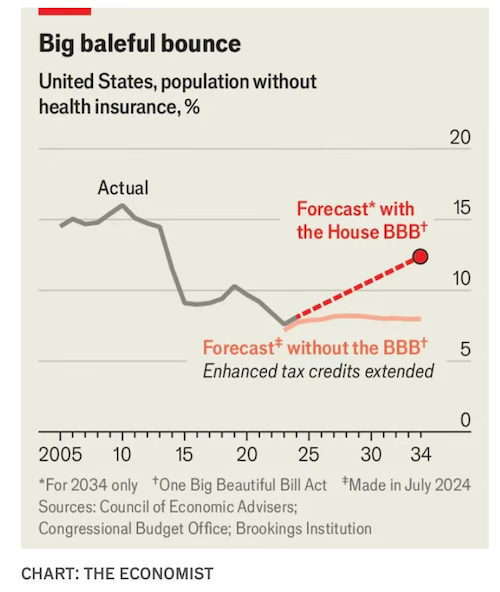
The Economist analyzed the impacts of the “One Big Beautiful Bill” on health care and concludes that “it brings the biggest changes to health policy since the Affordable Care Act.”4
15% ($1 trillion) less will be spend on Medicaid over the next decade.
10.9 million people will lose health insurance.
The uninsured rate is forecast to increase to 12%, a rate not seen since 2013.
States will have to decide whether to raise taxes, cut payments to health care providers, cover less people or cover less care.
Expiration of enhanced tax credits will result in health insurance for people earning around $60,000 going up by 75% for most, 90% for those in rural areas.
More than 300 hospitals may close due to the cuts.
Most of those who lose insurance or Medicaid delay taking medications and getting medical care, becoming sicker and poorer as a result.
Here’s an example of a bad faith statement:
The White House claims the cuts are “strengthening the integrity” of Medicaid. Brian Blase, who advised Republicans on the bill, frames it as a “course correction” from an “explosion of spending” under the previous administration. Certainly, spending has increased. But the reforms will not simply cut bloat while protecting the vulnerable. Instead, they will hit those least able to keep up with paperwork, with ripple effects well beyond Medicaid.
And if as President Trump says American's “won’t even notice” the cuts, why did Republicans time the cuts to hit after the mid-term elections. More bad faith.
As I argued in “The Budget and the Common Good”, I just can’t see how extending tax cuts for wealthier citizens and significantly increasing the deficit to do so justifies cutting basic health care for less wealthy and vulnerable citizens. I’d consider a proposal to reduce social benefit spending to reduce the deficit if the tax were allowed to expire. But that’s not what we got. When the health care cuts kick in, I expect we’ll see a correction, likely a populist trifecta - tax cuts, social benefit spending, even bigger budget deficits. And then a debt crisis will cause the whole house of cards to come tumbling down. Ugh.
Congress Sues
Members of Congress are excepting pressure upon the Trump administration.
Seven Democrats are using a decades-old statute known as “the rule of five” to demand the release of information related to the investigation of Jeffrey Epstein. This statute seems like it would bolster the Democrat’s power as a true opposition party.

A historical parallel here is worth noting. This 1928 law was passed in the wake of the Teapot Dome scandal…That scandal, which involved a corrupt Cabinet member under President Warren Harding taking bribes in exchange for oil leases, resulted in higher public awareness of governmental corruption and the need for better congressional oversight to ensure transparency.
Critically, though, the statute that Senate Democrats are now invoking…was originally designed to “ensure that the minority” in Congress “has real access to what executive agencies are doing.” As you may have noticed, this is a particularly urgent need right now: Democratic efforts at oversight have been entirely blocked by the GOP majority, which is devoted to protecting Trump at all costs.
Democracy Forward and 12 members of Congress filed a lawsuit against the Trump administration “challenging its unlawful obstruction of congressional oversight that the members have sought to conduct at federal immigration detention facilities, in which both citizens and noncitizens have been detained without due process”
The lawsuit5 cites “Congressional Oversight Power”,
“From the earliest times in its history, the Congress has assiduously performed an informing function” that permits members of Congress “to inquire into and publicize corruption,maladministration or inefficiency in agencies of the Government.” Watkins v. United States, 354 U.S…
The Supreme Court has long recognized that “the power to investigate is inherent in the power to make laws because a legislative body cannot legislate wisely or effectively in the absence of information respecting the conditions which the legislation is intended to affect or change.” “[W]here the legislative body does not itself possess the requisite information—which not infrequently is true—recourse must be had to others who do possess it.”
The power to “secure needed information” is thus firmly grounded in Congress’s duty and authority to exercise “[a]ll legislative powers” under article I of the U.S. Constitution.
This power to investigate “is as penetrating and far-reaching as the potential powerto enact and appropriate under the Constitution.” It “encompasses inquiries into,” among other things, “defects in our social, economic or political system for the purpose of enabling the Congress to remedy them.”
Congress exercises its investigative duty and authority in various ways. Through itscommittees, for example, it regularly requests and, when necessary, compels documents and testimony, including from executive branch officials. Individual members of Congress play distinct oversight roles, and “each member needs accurate information from the executive branch in order to make informed decisions on all sorts of matters.”
As a vigilant citizen, I’m hopeful that the minority party in Congress asserts its rights and power to become an effective opposition party, increasing transparency and holding those in power accountable for their actions.
Stefanie Stantcheva, “To understand America today, study the zero-sum mindset”, The Economist, July 7, 2025
“The voice of public choice”, The Economist, January 19, 2013
The Library of Economics and Liberty (Econlib, https://www.econlib.org) “is dedicated to advancing the study of economics, markets, and liberty. It offers a unique combination of resources for students, teachers, researchers, and aficionados of economic thought.” I perused the library and find its resources to be amazing in breadth, depth and range of media.
“The meaning of Trumpcare”, The Economist, July 16, 2025
Neguse et. al v. U.S. Immigrations and Customs Enforcement et. al., Case No. 1:25-cv-2463, United States District Court for the District of Columbia, July 25, 2025